The Museum Lace collection has a fine selection of Chemical Lace Ladies collars which are also referred to as Schiffli Lace.
Chemical Lace is a form of machine-made lace which required considerably less time to make and less human input compared to the cottage industry handmade lace but still required skilled machine operators to set up and manage the looms. This method of lace-making is done by embroidering a pattern on to a sacrificial fabric that has been chemically treated so as to disintegrate after the pattern has been created.
Schiffli machines came into use in the late 19th century. Before that, embroidery machines called Swiss hand machines were used to make chemical lace as well as embroideries. This embroidery is nowadays typically done on a multi-head or multi-needle Schiffli machine or loom that has a very large continuous and overlapping embroidery field. The lace pattern is designed such that the embroidery thread creates an interlocking series of threads that will, in essence, become a ‘stand-alone’ piece of lace. After the embroidery is completed, the embroidered fabric is immersed in a solution that will not harm the embroidery thread but completely dissolves the sacrificial fabric leaving just the lace.
The Schiffli embroidery machine is a multi-needle, industrial embroidery machine. It was invented by Isaak Grobli in 1863. It was especially used in the textile industry of easter Switzerland and Saxony Germany but also in the United Kingdom and the United States to create various types of machine embroidery and certain types of lace. Schiffli machines evolved from and eventually replaced manually operated ‘hand embroidery’ machines which used double ended needles and passed the needles completely through the fabric with a continuous single thread. Whereas the Schiffli machine used a lock stitch, the same technique used by the sewing machine. By the early twentieth century Schiffli machines had standardised to ten and fifteen metres in width and used more that 600 needles. The front side thread is held on a creel of spools. A boat-shaped (German Schiffli) shuttle carries the bobbin thread, one shuttle per needle. When the front-side needle pierces the fabric, it passes the embroidery thread through the fabric from front to rear. As the needle withdraws it forms a loop on the back side of the material. The shuttle which trails the bobbin passes through this loop. Finally, the front-side thread is pulled tight.
There is a very large Schiffli lace dress collar on display on the first floor and many smaller fine Schiffli lace collars are laid out in the ten pull-out wooden drawers beneath the Lace display case.
Vintage linen and clothing
In the second floor bedroom and parlour, there are examples of ladies’ vintage clothing and children’s christening gowns and slips, a local gentleman’s waistcoat worn travelling on American stagecoach’s in 19th/20th century, a silk scarf to commemorate Queen Victoria’s reign and a quilted bedcover.
Stoneware
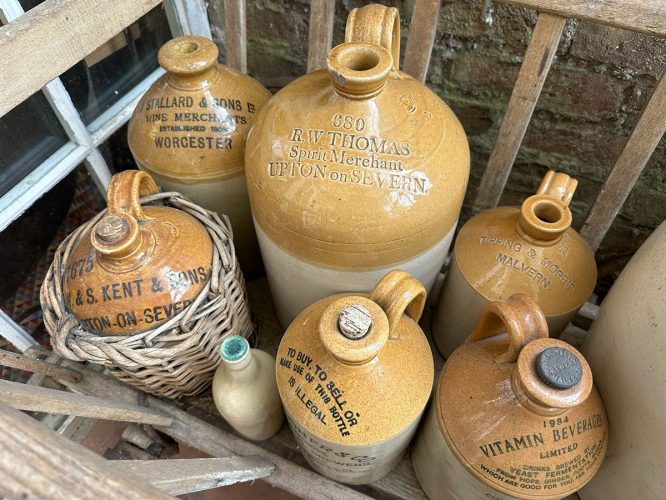
The Museum has a variety of stoneware, including large jars, ink pots, a hot water bottle (near the bed on the first floor) [add exhibits here] The stoneware here is mostly C19 Bristol ware. It is highly glazed, and its surface is vitrified (like glass)
Stoneware is a non-porous ceramic, which is watertight even without a glaze. It is fired at a high temperature between 1,100 to 1,300 C. Reaching that temperature was a great challenge for early potters to achieve.
We know that some of our pots were made by Powells of Bristol and by their successors (in 1907) Price, Powell and Company of Bristol because of the stamps in their necks. They operated from Prices Pottery St Thomas Street.
The clay for our stoneware came in blocks to Bristol from Dorset by boat. The wet clay blocks were dried at the sides of the kilns on the pot bank. They were then pulverised, mixed with crushed quartz and felspar and rehydrated to make a useable clay.
The clay was then thrown to make spirit jars, barrels, preserve jars, ink pots, or moulded to make footwarmers and hot water bottles, pipes and filters.
Before glazing, the names of the companies they were made for were added by rubber stamp or by transfer. (See W.& S. Kent & Sons Upton)
The company also made insulators, accumulators and battery jars for the electrical industry; water pipes, drains and sewers for buildings and roads.